Weakening ULA Will Make Housing Less Affordable for Everyone in L.A.
Weakening ULA will make housing less affordable for everyone in L.A.
Tomorrow, the Ad Hoc Committee on United to House Los Angeles will hold its first meeting. They should not rush to weaken one of the city’s few voter-approved tools for keeping people housed.
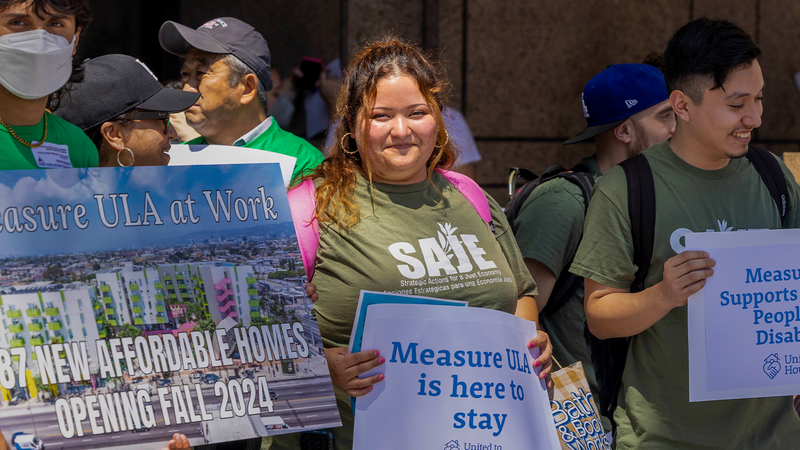
Measure ULA was passed by Los Angeles voters to create a dedicated, locally controlled source of funding to keep people housed, build more affordable homes, and prevent homelessness before it starts. At its core, ULA is about stabilizing a broken housing system by pairing housing production with tenant protections, homelessness prevention, and strong public oversight in a region where too many people are one emergency, one rent increase, or one eviction notice away from losing their home.
ULA revenue has already funded 795 units of affordable housing, helped keep more than 10,000 people housed, and funded legal services for tens of thousands more. That is what is at stake as efforts are underway to weaken the measure.
A new report commissioned by Liberty Hill and prepared by BAE Urban Economics adds an important perspective to the debate. Liberty Hill did not conduct the data analysis; we asked an independent third-party firm to take a close look at the facts because we believe decisions about ULA should be grounded in evidence, not just political pressure. Critics say weakening ULA would help unlock major new housing development. But the report suggests otherwise: in most cases, waiving ULA would make very few projects newly feasible and would mostly benefit projects that are already feasible, or would become feasible if owners simply held them longer before selling.
That finding matters. It also fits a familiar pattern: when policies are proposed to redistribute resources and strengthen economic security, opponents often predict disaster. We have seen this playbook before, from minimum-wage fights to other efforts to rebalance who benefits from public policy. And just as often, those warnings turn out to be exaggerated or wrong.
Too much of this debate has been narrowed to a technical argument about whether one policy or another is affecting the market at the margins. That is a convenient frame for people invested in the status quo. But L.A. should be asking bigger questions: Who has our housing system worked for? Who has it failed? And what are we willing to do to build a Los Angeles where more people can stay rooted in the communities they call home? And most importantly, who really benefits from recent efforts to try and claw back ULA?
Los Angeles has made meaningful progress in recent years. Evictions in Greater Los Angeles fell by 16 percent, and homelessness declined for the second year in a row as prevention efforts helped the rehousing system begin to catch up. That progress did not happen by accident. It happened because communities fought for bold solutions, and because local government began to make bigger investments in keeping people housed. That includes ULA in the City of Los Angeles and Measure A in the county, both of which support prevention efforts like Stay Housed LA.
Big swings create progress. They also create backlash.
We are seeing that backlash now. And in moments like this, it is easy to get pulled into narrow debates and lose sight of the deeper issue: the status quo has long favored wealth, property, and entrenched advantage, while renters, low-income families, and unhoused Angelenos are asked to absorb the instability.
That imbalance shows up everywhere in our housing system. Public policy has long made room for large-scale benefits that protect wealth and homeownership, while treating assistance for low-income renters as conditional, limited, or politically expendable. Measure ULA is one attempt to change that equation — to say clearly that public resources should also be used to keep people housed, prevent homelessness, and build a fairer Los Angeles.
The new BAE analysis is useful because it responds to one of the main arguments being made against ULA: that waiving it would unlock significant new development. The report suggests that is not the case. Instead, it finds that a waiver would make very few projects feasible and would mainly benefit a narrow slice of projects that are already feasible, or would become feasible if owners simply held them longer before selling.
Before city leaders move to weaken ULA, they should be honest about the tradeoffs. What housing and homelessness-prevention resources would be lost? Which families would be left with less support? And why should Angelenos walk away from a voter-approved tool that is helping the city move in a better direction?
Measure ULA reflects a basic truth: housing justice requires more than market optimism. It requires public will, community accountability, and real investment in prevention. At Liberty Hill, we believe in building the good. We believe Los Angeles can choose a future where more people are housed, more communities are stable, and more public policy is shaped by basic decency instead of resignation. That future will require courage. It will require defending bold solutions when they are attacked. And it will require remembering that the point is not just to protect a policy, but to build a Los Angeles where everyone has a real chance to stay, belong, and thrive.