
Funding Black Permanency Means Investing Beyond the Next Crisis
I first heard the idea of Black Permanence while hiking through the mountains of the San Fernando Valley. My friend, Kaci Patterson, shared the idea she had developed and I felt the truth and power of it instantly.
Fast forward a couple of years, and her idea has become a new standard for philanthropy to aspire to. This May, Kaci invited me to join Brenda Solórzano, President and CEO of The California Endowment, and Richard Tate, President and CEO of The California Wellness Foundation, at the Black Equity Collective’s 5th Annual Equity & Justice Symposium, themed The Arc of Black Permanence®.
This was not your ordinary conversation between foundations and community organizations — funders listening to politely stated needs and responding with elaborate processes to follow for a chance to get those needs met. No, that’s not how Kaci does things. She put us in a room filled with Black community leaders, workers, and employers, and asked us to account for how our institutions are investing in Black Permanency and influencing others to do the same.
What is Black Permanency® ?
It’s building the conditions for Black people, organizations, cultural institutions, leadership, and community power to remain rooted, grow, and shape the future across generations. As the Black Permanency site aptly states, “It moves us beyond temporary solutions toward lasting systems, deep investment, and collective power that secure our future and honor our legacy.” (www.blackpermanency.com)
What does this look like in practice?
Liberty Hill partner Students Deserve offers a powerful example.
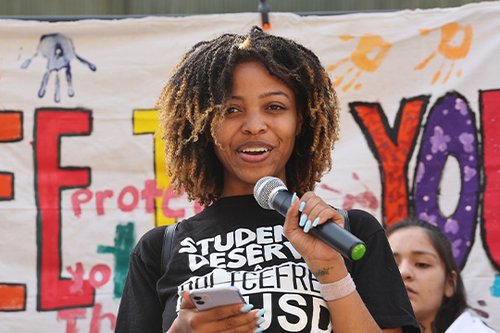
Pictured, Student Activist with Students Deserve at a rally
After years of Black student-led organizing, Students Deserve and others helped win a historic $25 million divestment from school police and pushed LAUSD to reinvest those dollars in the Black Student Achievement Plan.
The point was never simply to remove something negative from schools; it was to build lasting infrastructure for Black students, including academic counselors, psychiatric social workers, restorative justice supports, school-climate staff, college counseling, and other resources designed to help Black students learn, belong, and thrive.
Since 2021, the Black Student Achievement Plan has grown from $37 million to $135 million, demonstrating what becomes possible when organizing wins are translated into durable public investment.
The Los Angeles Black Worker Center—the first Black worker center in California— has also built lasting infrastructure for Black worker power, serving as the hub for a regional organizer network that stretches across Southern California. They have led efforts to secure landmark labor agreements with LA Metro, ensuring that 40% of construction hours go to local workers from underemployed areas. They were also instrumental in organizing to create the City of Los Angeles’ first-ever Civil and Human Rights Department tasked with investigating discrimination and protecting vulnerable members of the workforce.
Both of these organizations show what becomes possible when Black-led organizing is funded not simply to respond to a moment, but to build for the future. Permanency means ensuring Black-led organizations have the long-term resources to keep organizing, monitoring implementation, developing new generations of leaders, and protecting these gains long after the political moment that made them possible has passed.
Challenging the Status Quo
This framework challenges a familiar philanthropic pattern. Black-led organizations are often called upon in times of crisis to solve problems centuries in the making with short-term or restricted grants that leave too little room to invest in leadership, reserves, technology, organizing capacity, or the infrastructure needed for what comes next.
Kaci calls this “funding pain management.”
At the Symposium, she said “communities have been forced to manage our own decline and to do our best to mitigate the acceleration of that decline through service provision and incremental policy change. But as we talk about how to build for the future, we cannot ignore that building upon the same norms will eventually produce the same inequitable outcomes.”
For funders, investing in permanence creates stronger partners, healthier organizations, more durable movements, and a philanthropic ecosystem better equipped to achieve long-term goals.
At Liberty Hill, our 50-year history has taught us that lasting change comes from investing beyond an individual program or grant cycle. Uplifting Change is one example: it brought Black donor activists, philanthropic leaders, and movement organizers together to invest in grassroots organizing and helped nurture a broader culture of Black philanthropy and collective giving at Liberty Hill. Kaci was among the leaders who helped shape that work, alongside many others whose leadership continues to influence us today.
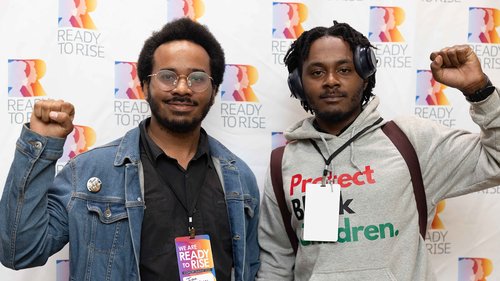
Pictured, Ready to Rise partners at a recent convening
The Ready to Rise program offers a concrete example of what investing in Black Permanency can look like at an ecosystem level.
This youth development initiative supports approximately 100 community-based organizations across Los Angeles County, of which 40% are Black-led. That means roughly 40 Black-led organizations are receiving resources, relationships, and technical assistance. Together, we are building a community-led youth development system that is keeping kids out of jail and helping them tap into their power and fulfil their potential.
The value of that investment is not only in the dollars distributed, but in helping Black-led organizations become stronger and more durable. Permanency requires Black-led organizations to have the capacity to survive changes in political leadership, public funding, philanthropic priorities, and moments of crisis. It means helping organizations strengthen their staff, leadership, financial systems, partnerships, and ability to secure future resources so they can remain rooted in their communities for decades.
That is Change, Not Charity: moving beyond easing the symptoms of injustice to changing conditions at the root and expanding power and self-determination.
Philanthropy understands the value of permanence, by another name: perpetuity.
Foundations build and protect their endowments for perpetuity so resources remain available through economic downturns, political shifts, leadership transitions, and changing priorities. That long horizon gives institutions the freedom to plan, take risks, build infrastructure, and pursue a mission over generations.
Black leaders are calling on philanthropy to bring that same long-term thinking to Black communities.
In practice, funding for permanence looks like multi-year general operating support; investment in leadership, staff, technology, reserves, and organizing capacity; and decision-making processes that bring community expertise in early enough to shape priorities and strategy.
All the things philanthropic institutions do for themselves.
Black Permanency is not a program philanthropy can design for Black communities. It is a vision Black leaders are articulating for themselves.
Our role is to listen, invest, share power, and remain accountable — following Black leadership while using the influence we have to bring more resources and more institutions into the work.